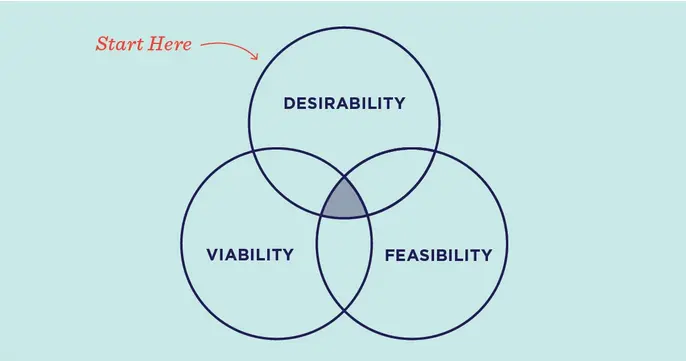
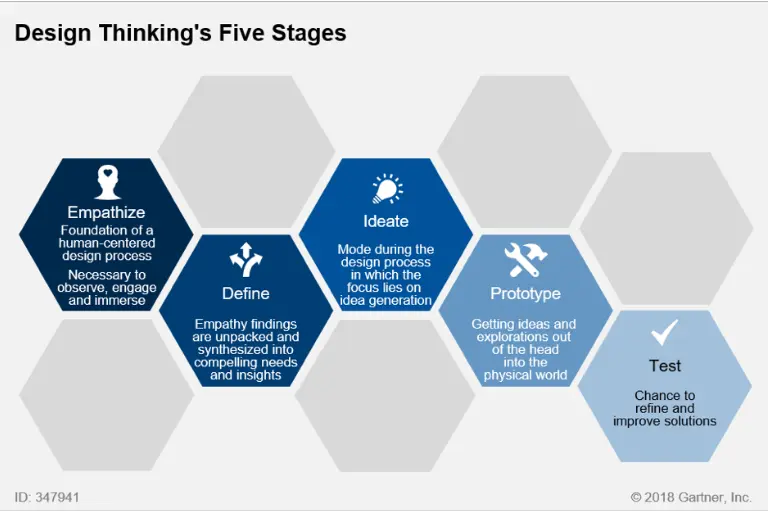
Companies from Pfizer to Airbnb have used Design Thinking to uncover and meet user needs through five simple steps, which can take place sequentially or run in parallel.
- Empathize. Learn about the audience for whom you are designing
Humans should be at the heart of the process. When was the last time you spoke at some length with a client about their experience with your company? This can be very simple to set up. Nielsen Norman Group, a leader in the user experience field, has published research that shows that speaking with
groups of five customers in the same segment can provide nearly 80% of the feedback themes for a product, service, or experience that you would normally get from a much larger sample size.
- Define. State the problem and interpret the results
Construct a point of view based on user needs and insights. The “define stage” will help the designers in your team gather great ideas to establish features, functions and any other elements that will allow them to solve the problems or, at the very least, allow users to resolve issues themselves with the minimum of difficulty.
- Ideate. Conduct an expansive brainstorm to come up with creative solutions
The main aim of the ideation stage is to use creativity and innovation in order to develop solutions. Ideation will help you to ask the right questions and bring together perspectives and strengths of team members.
- Prototype. Build representations of idea(s) to show to users
Prototyping allows you to get ideas into physical form to gain feedback from the people they are intended to serve. The goal is to start with a low fidelity version of the intended solution and improve it based on feedback.
- Test. Return to original user to test for feedback and iteration
This is the most crucial step in the process. It is in a way the moment of truth. It’s where you find out if you’ve correctly identified your user’s problems, if your prototype is close to the solution they want, if you need to make changes to your design.